FREE NATIONWIDE SHIPPING ON ORDERS OVER P1500!


The Snappi® Diaper Fastener revolutionized cloth diapering over 25 years ago! This all-in-one diaper fastener offers a practical and reliable way to fasten a cloth diaper. It is the cloth diapering necessity that “PULLS IT ALL TOGETHER.”™

DIRECTIONS FOR USE:
Snappi® fasteners must be used responsibly, and need to be used correctly in order to work effectively.
STRETCH the Snappi® fastener before its first use. The stretching triggers the ‘memory’ of the Snappi® to return to its original size, and in doing so, will pull the diaper to the middle to allow for a snug fit. It also makes it more pliable/elastic and therefore easier to use. This is essential for the Snappi® to work properly.

Stretch the Snappi® by holding it in the center with one hand and with your other hand, grab close to the end of one of the arms, avoiding the sharp teeth, and pull. Do not grab the Snappi by the loops. Repeat this about 10 times for each arm. You will notice the material begin to soften up and become more elastic. Once you do this for each arm your Snappi Diaper Fastener is ready for use!

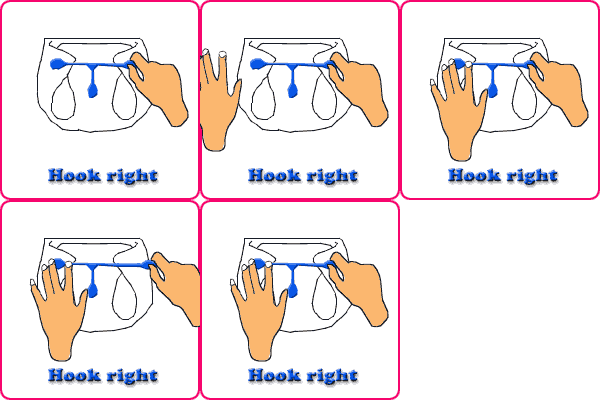

Holding the diaper in place with one hand, attach the Snappi® with the other hand in 3 simple easy steps:
In other words, the Snappi® fastener should go from a ‘T’ shape to a ‘Y’ shape.
When attaching the Snappi®, hold onto the solid part of the tab. DO NOT pull on the loops.
Make sure that the Snappi® teeth have gripped properly into the diaper fabric and that it is ATTACHED SECURELY with all 3 arms. The 3 points of tension are important as it is the third arm that will help prevent the Snappi from coming undone.
By following these instructions, the Snappi® should be secure and the diaper will fit snugly. It is ESSENTIAL to use a cover over the diaper and Snappi® fastener.
Snappi®s WORK BEST with terry cloth diapers, prefolds, and any other cloth diapers with a loose enough weave for the Snappi® to hook into. They DO NOT work well with tightly woven diapers, or diapers made from delicate fibres. They are only recommended for diapers where the diaper fabric is thick enough that the teeth on the grips do not touch baby’s skin.
By following these instructions, the Snappi® should be secure and the diaper will fit snugly.
WARNING:
1. A Snappi® is NOT A TOY. Keep out of children’s reach when not in use!
2. Replace your Snappi® if there is any physical damage or weak spots.
3. Do NOT use a Snappi® on a child who is able to undo it or remove their diaper/diaper cover/clothing.
4. Snappi®s should only be fastened by an adult.
5. Use a cover over a Snappi® fastener.
6. Do not leave your Snappi® in the sun for extended periods as this can eventually weaken the Snappi®.
CARE:
Clean your Snappi® in hot soapy water. Do not launder with diapers in the washer as the grips could damage your diapers.
CAUTION:
- Any tear in the Snappi® can lead to separation of a piece, presenting a possible choking hazard.
- Do not cut your Snappi® as this could create weak spots in your Snappi®.
- Do not pull on the loops of the Snappi® when attaching, as this can cause breakage. These loops serve as a safety feature only, as explained above. Use the flat, solid tabs for leverage.
- Inspect your Snappi® before each use. Discontinue use immediately if there is any sign of cracking, tearing, breakage or wear of any parts.
MATERIALS
The Snappi® fastener is manufactured from FDA approved raw materials, which are degradable. It contains NO latex, silicone or any other adulterant, dilutent or modifying polymers. Snappis are CPSIA compliant for lead and phthalate content. Snappi®s are made in South Africa.
EXTRA SAFETY FEATURE:
When the Snappi® fastener is not in use, fold the loop over the back of the Snappi® end to fit over the teeth of the white grips –see photo below. This acts as a barrier and prevents the sharp teeth from being exposed.
NOTE: The loops are NOT to be pulled when attaching the Snappi® fastener to the diaper. When attaching the Snappi®, hold onto the solid part of the tab.
WARNING: Keep Snappi® fasteners out of children’s reach when not in use.
